DISARM ICE --- LET THE POLICE CATCH REAL CRIMINALS --- DEMAND ACCOUNTABILITY ---
Showing posts with label books. Show all posts

Saturday, March 21, 2026

Crazy Brave: A Memoir

photo: Shawn Miller
Joy Harjo's memoir provides some valuable insights into what it is like to grow up as a minority person surrounded by an often-hostile dominant culture.  In addition to that cultural challenge, Harjo also had to contend wirh violent abuse by her step-father which ultimately drove her to abandon her family home as a teenager.  Just surviving those experiences seems remarkable enough, but on top of that Harjo found her way to a functional and productive adult life;  a life which included becoming the first Native American Poet Laureate of the United States.

What struck me early on in Harjo's story was how much it resembled the story of another woman half a world away, that of novelist Arundhati  Roy.  As a member of a Syrian Christian family Roy had to constantly contend with living in the shadow of the Hindu majority.  She also, like Harjo, was subjected to parental abuse which drove her to leave home as a teenager, and to negotiate a precarious voyage to adulthood to ultimately achieve success at the highest level. 

Both women were highly intelligent and both showed early interest in creative pursuits which seemed to help to sustain their dreams in the face of daunting circumstances.  Were those traits the secret to their ultimate successes?  Many others with similar traits and experiences must have proceeded into unsatisfying lives and untimely deaths.  Sheer luck certainly played a role.

I am left wondering if Harjo and Roy ever had the chance to sit down together to compare their life experiences or, if not, how such a meeting might help us to understand how devastating early adversity might be overcome. 

Wednesday, January 28, 2026

Survivor

I just finished reading another book by one of my great favorite writers, Arundhati Roy.  Mother Mary Comes to Me is autobiography, telling what it was like to grow up in India in the care of a mother who provided life lessons embedded in nightmares.  The story is an excellent example of how some children endure horrific life conditions and yet seem to arrive at adulthood with functional personalities supporting often successful and rewarding lives. 

Roy left home as a teenager, unable to support her mother's continuous abuse.  She got herself through school to a degree in architecture, but it still took her many years to climb out of poverty.  She spent four years writing her first novel, The God of Small Things, which won the Booker Prize and made her wealthy.

Beyond recounting her personal story Roy also provides a first-hand account of India's  history which cannot be found easily in journalistic reports.  Roy lived through Ghandi's era and the following genocidal clashes of Hindus and Moslems, and the rise of the current authoritarian Hindu state under Narendra Modi and the BJP.

In the face of those challenges Roy became an activist supporting resistance against giant dams which displaced vast numbers of rural people, as well as reporting about the on-going persecution of the Moslem population of Kashmir, about which she wrote another of her popular novels.   Roy, like her mother, has also been a champion of women's rights in India.  That and her political  activism has made her the target of constant threats and governmental persecution.  In spite of that, when she could live in ease in any part of the world, she continues to live and work in Delhi.

As I wrote in one of my previous posts about Arundhati Roy, 

"Americans don't pay a lot of attention to what is going on in India,  but we make that choice at our own peril."

Tuesday, June 24, 2025

Singing the Blues

 I've read two books recently on the subject of music, but I still don't have any sense of rhythm. I can't say I''m surprised at that outcome.  However, there are dimensions to music beyond the tap - tap - tap.  I feel I have at least made some gains in historical perspective about blues and jazz traditions thanks to Blues Legacies and Black Feminism by Angela Y. Davis.

"Ma" Rainey
Davis goes near to the beginnings of the Blues story in the 1920s with Gertrude "Ma" Rainey, and shortly afterward as the torch is passed on to Bessie Smith.  Davis provides a very thorough account of how the themes and forms of the Blues developed out of the daily life struggles of those performers, including the challenges of segregation and racism.  Davis' book provides a context for the period that I had not seen anywhere before.  The quality of the early recordings is not always the best, but the last half of the book contains the complete lyrics of all the songs.


Billie Holiday - Wikipedia
 A couple of the last chapters in Davis' book are devoted to the career of one of my long-time favorites, Billie Holiday.  While the earlier Blues performers are lauded in the book for their expressions of Black culture, language and experience, Holiday's contribution - as portrayed by Davis - was primarily a combination of courage and political conviction.  What Davis was talking about, of course, was the creation of a song from the poem by Abel Meeropol, Strange Fruit. To champion and perform a popular song about lynching was quite a gamble in 1939, but it is hard to imagine any work of art in any genre ultimately  having more social and political impact.

When I actually got around to listening to some of the early recorded performances by "Ma" Rainey and Bessie Smith I was delighted to realize that I already knew some of their songs.  It turns out that quite a few of those early Blues tunes were picked up and performed by another great favorite closer to my time, Nina Simone. There is also a clear parallel from Holiday to Simone in the latter's 1964 composition and recording of Mississippi Goddam(Picture of Nina Simone by By Gerrit de Bruin - in Wikipedia)

Tuesday, June 3, 2025

The Immigrant Experience

Something to Declare by Julia Alvarez is a series of articles and essays about adapting to a new culture and a new language after fleeing to the U.S.  to escape an imminent threat in the Dominican Republic which was then ruled by a dictatorship led by Rafael Trujillo.  As I wrote here before, I have long been a enthusiastic follower of Alvarez's writing. It has always seemed amazing to me that someone could arrive here as a child with only a rudimentary grasp of English and end up being recognized as one of the greats among contemporary authors writing in English.


American Dirt
by Jeanine Cummins is a novel about the flight from horrific violence which has driven so many Mexicans to seek refuge in the United States.  The author spent four years researching and writing the story of how a mother and her young son traverse the length of Mexico overland while under constant threat from cartel gangsters and the often corrupt and equally violent police. Much of the vertiginous journey is on top of railcars of north-bound trains referred to as La Bestia. The final leg is under the guidance of human traffickers through the unforgiving Sonoran Desert which has claimed countless migrant lives.


Dreaming of Home
by Cristina Jimenez tells the story of being brought to the U.S. as a child by her parents who were fleeing violence and a chaotic economy in Ecuador.  Jimenez recounts the trauma of growing up in a country in which she felt unwanted and in constant fear of deportation due to a lack of documentation.  Eventually, fellow students and teachers helped her toward the courage to speak out about the fundamental human rights due to her and her generation of young immigrants.  She is Co-Founder and former Executive Director of  United We Dream, the largest immigrant youth-led organization in the country, and she is currently a Distinguished Lecturer with the City College of New York’s Colin Powell School and a co-instructor with Leadership for Democracy and Social Justice. Jimenez was instrumental in United We Dream’s successful campaign for President Obama to sign Deferred Action for Childhood Arrivals (DACA) into law.

Wednesday, April 23, 2025

Something to Declare

An online search failed to turn up anything interesting to read, so I started poking around in my book shelves.  I found a copy of Something to Declare by Julia Alvarez that I had somehow never read.  That was a surprise because she is one of my favorites and I have read most of what she has written.

The book is a collection of short articles and essays written over a period of years about the author's experiences as an immigrant to the U.S.  She recounts her early childhood in the Dominican Republic within a large and prosperous family, including her three sisters. Her father was a doctor and her beloved grandfather a cultural affairs delegate to the United Nations. What soon became obvious was that status and wealth were no barriers to the scrutiny of the dictator Trujillo's secret police.

The family's vulnerability was increased by the fact that Alvarez's father owned a prohibited firearm and he was a participant in the clandestine resistance to the dictatorship. When a secret police vehicle started blocking their driveway at night it was clear that the time had come to escape the island.  

Permission to travel to the United States was narrowly obtained on the pretext of advanced surgical studies by the father.  The family's wealth and connections allowed them to fly to New York where they found asylum, and thus began Julia's challenge of learning to navigate a new culture and a new language. Her long list of well-received books in her adopted language is a testament to her arduous but successful journey.  

Sunday, March 23, 2025

Barbra

I had scanned the books in half a dozen library aisles when I was surprised to come across Barbra Streisand's autobiography, My Name is Barbra. I had read a couple reviews, so I decided to check out the book.

I remember when I first became aware of Barbra Streisand's appearance in the media in 1960s New York.  My girlfriend at the time - also born with the name Barbara and also from Brooklyn - dismissed Streisand as just another singer among many ambitious little Jewish girls from Brooklyn at the time.  That turned out to be quite an underestimation.

I was never a fan of the kind of Broadway-style songs that Streisand favored and being essentially amusical I found it easy to ignore her career for sixty years until I came across her book. After reading the book I now count myself a fan, more for her writing than her singing perhaps, though I have now taken the time to actually see and appreciate some of her performances online.

In the book's 970 pages Streisand tells a really captivating story of talent, crativity and tenacity, and she does so with a very east-to-read, conversational writing style. She spent ten years pulling together the story from her journals, detailing her early successes as a singer and the achievement of her dream of becoming an actor, and then moving on to being a writer, producer and director of films.  Along the way she meets and often works with every famous person you ever heard of.

Among the performances I found on Youtube, the one I liked best was from the live concert in Anaheim in July 1994. In that she sings many of the songs she talks about in her book.

Thursday, October 5, 2023

Adventures in the Multiverse

 I entertain the thought at times that I am making some progress toward emerging from musical illiteracy, but then something comes along to correct that idea. Most recently I was brought back to reality by the discovery of Patti Smith.  I would hope I am not the last person on Earth to find her, but I have to admit the possibility. 

In my defense I am pretty sure that Patti Smith and I inhabited parallel universes which only intersected a few days ago when I stumbled on a picture of her on the cover of one of her books in which she is arm in arm with the photographer, Robert Mapplethorpe. That improbable pairing prompted me to download her book, Just Kids, to my Kindle.

Just a few pages into the book I found that we were both wandering around the streets of New York's East Village in the late 1960s, eating in the same cheap Polish restaurants and searching for a new life vastly different to what we had known up to that point. A few years older than her,  I had made it all the way through college and was able to find work pretty easily. She often slept in the street and really lived hand to mouth for a couple years.

Part of my NYC journey was spent in a basement photography school in the Financial District learning the basics of the craft. Patti Smith developed an interest in photography which included a life-long attachment to a Polaroid 250. (One of the polaroids in her Instagram stream shows the Gem Spa at 2nd and Saint Marks which was just a couple blocks from where I lived.) From there our paths diverged significantly.  My path led me through San Francisco and Idaho to New Mexico.  Patti Smith, after the rocky beginning mostly stayed in NYC, always knowing who she was and working toward achieving fame as a writer, poet, artist and musician.

I thought Just Kids was excellent and I finished it in a couple days.  Her Instagram stream is also worth a visit; it was recently turned into a book as well.

Monday, September 18, 2023

Chile, 50 Years Beyond the Coup


Pascale Bonnefoy
We spent two hours on Sunday at the Art Museum listening to a marvelous lecture about Chile's recovery from the Pinochet coup.  The speaker was Pascale Bonnefoy, an investigative journalist based in Santiago, Chile, and associate professor of journalism at the University of Chile, Santiago.

Seventeen years after the 1973 coup which ended the Allende presidency the Chileans voted the dictator out of office.  That unique termination of a dictatorship was accomplished only with carefully crafted compromises, the first of which was to grant amnesty to Pinochet and to leave him as the commander of the armed forces for eight years after he stepped down from the highest office.

While many of those responsible for the torture and murder of thousands of Chileans remained safe from prosecution for a time as well, the advocates of human rights gradually assembled the facts of the period and identified the perpetrators, many of whom are only now being brought to justice.  Pinochet, however,  escaped that justice.  He always denied any direct knowledge or responsibility for the human rights abuses and in the end he threw his subordinates under the bus.  So, while he was able to die in his own bed, he did ultimately earn the hate, not only of most of the citizens, but also of the army that had supported him.

Bonnefoy spent years assembling the story of the search for justice in Chile and produced a detailed account of it in her book, The Investigative Brigade.

------------------

The story continues:

Aljazeera 29 Aug 2023

Chile court upholds jail term for retired soldiers over Victor Jara murder.

Monday, July 3, 2023

An American Radical


I have hesitated writing about Susan L. Rosenberg and her book, An American Radical:: Political Prisoner in My Own Country I came across the book recently by accident while browsing through biographies in the collection of my local library.  It was published over twenty years ago and therefore not in great demand and easily available.

It may be the best book I have ever read.  I'm sure I will be unable to adequately support that judgement with my words.  Of course, that is of no real consequence since anyone else can easily acquire the book and make their own judgements about its value.

Rosenberg was arrested in 1984 in the act of transporting explosives and guns to support armed rebellion.  She was given a fifty-eight year sentence, of which she spent sixteen in high-security prisons around the country.  She ultimately won a commutation of her sentence in the last hours of the Clinton presidency.

An American Radical presents a vividly detailed account of what it is like to face a life in the American system of incarceration.  Rosenberg survived the experience thanks to allies in and out of prison, along with her stamina, intellectual capacities, and emotional resilience.  Those same qualities allowed her to craft her epic story and -- unlike the vast majority of inmates -- to come out a better, more complete, person than when she went in.

Thursday, May 11, 2023

Reflections

I went by my favorite local used bookstore recently and found Lawrence Durrell's Reflections on a Marine Venus.  The text seems very familiar, so I'm pretty sure I read it originally just before we went to Greece nearly twenty years ago.

I first became acquainted with Durrell's work through his Alexandria Quartet which I read while in school in the 1960s.  That seemed revolutionary then to me in its style and content.  Looking back on it now I'm thinking maybe the issue was more my own literary naivetĂ© at the time.  Durrell was in the employ of the Foreign Office during his time in the Dodecanese Islands and his views and opinions seem to reflect a now stale colonialist viewpoint.  To be fair I should probably go back and re-read the Quartet which he put together a decade afterward.

Thinking about Durrell and Greece got me thinking about pictures I had made there.  I posted a few on my photography blog over the years, but most were archived on Photonet.  When I looked at them there recently I found that the text of the photo essays I did had disappeared and accessing the photos was a slow process which augurs poorly for their preservation there.  So, I collected the lot and posted them on my Photography & Vintage Cameras blog in three parts labeled Rhodes, Symi and Athens.

Wednesday, December 28, 2022

Reading

 River of Shadows: Eadweard Muybridge and the Technological Wild West by Rebecca Solnit.

I'd only read Solnit's political commentary until I picked up this book at my favorite used book shop in Albuquerque.  In River of Shadows she provides a lot of detail about Muybridge and his extraordinary innovations in photography, but she also gives historical context to his life at the end of the 19th Century.  I only had given the photographer passing attention because of his high speed photos of animal locomotion.  As Solnit documents, however, before he invented a whole new genre of the art Muybridge was a practitioner of landscape photography in the heroic tradition of wet plates and giant cameras. She also details the photographer's abrupt personality change following a head injury which led to his becoming a murderer, and perhaps contributed to his inventiveness.

Solnit's writing style is dense with ideas and requires more attention than I was sometimes able to summon with my bedtime reading habit.  She also left some things unexplained about the technical aspects of Muybridge's innovations in high-speed photography.  Solnit and others allege that Muybridge achieved shutter speeds in excess of 1/1000 seconds.  That seems feasible and true in regard to the mechanical accomplishment and the published results, but there must also have been some chemical innovations in creating adequate plate sensitivity and processing to allow actual recording of the images.  It would be interesting to see the actual negatives which apparently needed some considerable amount of embellishment to produce the positives.  

There is also no mention in Solnit's account of supplemental lighting to make the high-speed images.  Edison invented the electric bulb in 1880 and the two inventors knew each other, so there is that.  More important, perhaps, is the fact that Muybridge played a fundamental role in the invention of moving pictures which Edison capitalized on.


Timebends: A Life by Arthur Miller.

Miller's memoir was in the 99-cent sidewalk bin, also at Mecca Music & Books.  I'm not sure what inspired me to pick it up other than the price and the 500-page heft.  I also can't discount the novelty of his marriages to two celebrities, Marilyn Monroe and Magnum photographer, Inge Morath.  So, I took home the book and -- 100 pages into it -- I am now quite taken with Miller's apparent total recall and the color it gives to my own vague recollections of what my grandparents told me of their time.

Life was radically different in many ways during the first part of the Twentieth, particularly in regard to the concept of time and how it was spent mostly in meeting basic daily needs, much as was the case for centuries before.  Then, industrialization gained transformative inertia, propelling us into an era of ease and terror.  In spite of the contrasts between the beginning and the end of the Century,  Miller's account of the politics of his time are oddly echoed in ours.  Both eras saw the rise of authoritarian, fascist ideologies, a fact which is simultaneously troubling and comforting in that it provides a vision of turning tides.

So, the narratives of Miller and Solnit provide some insights into the great transitions which humanity  has experienced over the last century.  His style makes for easier reading and I may have more to say about the life he recounts by the time I get to the ending.

----------------------------------

UPDATE

Margaret also read the book.  Like me, she found the middle of the book tiring because of Miller's obsession with critical reviews of his plays.  Further on, Miller regains his feet and provides an absorbing narrative including his sympathetic portrayal of Marilyn and her predictable end.  A happy ending was provided by his final twenty year marriage to photographer, Inge Morath.

Saturday, October 8, 2022

Beaming Down

 I mentioned watching Star Trek in the 1970s in a recent post along with the thought that the money spent on putting humans in space would be better spent on the ground.  Now I see that, rather surprisingly, William Shatner seems to be in agreement with that idea.  He has a new book out, Boldly Go: Reflections on a Life of Awe and Wonder, with essays about his life including his thoughts following his recent brief trip into the stratosphere. What he says about the perspective he gained from the experience seems to go against the image I had formed of him as a promoter of big tech and spaceflight enterprises.  

The excerpt from the book, was posted on Slashdot and the responses were generally favorable; also a little surprising given the appeal of that site to the tech nerds, nihilists and anarchists.  There is a co-author, Joshua Brandon, so it is not possible to know how much of the writing was actually penned by Shatner.  However, Shatner is clearly endorsing the content.

National Air and Space Museum model

Monday, September 12, 2022

Recommended Reading

A friend recommended a novel to me recently, The Island of Missing Trees by Elif Shafak.  I looked through her copy briefly and was skeptical about the story on two counts.  It starts out looking like a coming-of-age chronicle about a London teenager, and the main narrator is a fig tree!

I looked up the book on Amazon and the synopsis there showed that there was more to the story and that it dealt mostly with Cyprus and its turbulent history.  That was a topic of interest to me,  and it reminded me of Lawrence Durrell's book, Bitter Lemons, which I had enjoyed many years ago. So I bought the Kindle version and was glad in the end that I did.

Shafak skillfully ties together complex themes of history, ethnic antagonisms, personality development and ecology.  Her conscription of a tree as narrator, while seemingly improbable, turned out to be an inspired choice which made me rethink my own ideas about literary style.  

The omniscient narrator that carries the story in most novels really has no more grounding in reality than Shafak's fig tree.  The author actually does make use of the third person point of view to carry much of the plot's action, while the consciousness of the tree provides perspective as well as a surprising but satisfying ending to the story.  While I think the technique of jumping back and forth in time is much over-used to maintain suspense, Shafak uses it very effectively to explain the development of personalities and relationships.

Shafak's Amazon author's page shows some impressive academic credentials which give weight to the research acknowledgements in the book's endnotes, and she clearly drew on her own personal history of emigration in crafting the plot and characters of The Island of Missing Trees.

------------------

Update:

Take twenty minutes to watch a TED Talk by Shafak.  It will explain a lot about her writing purposes and style.  She is multi-cultural, multi-lingual and impressively articulate. She writes in both Turkish and English.

Thursday, September 1, 2016

Picasso: Creator and Destroyer

The Weeping Woman - Picasso - 1937
I am about two-thirds of the way through the biography of Picasso written by Arianna Huffington which first appeared in 1988.  The author does a thorough job of documenting the artist's manipulative, sadistic personality.  His talent and fame enabled consistent and prolonged duplicitous behavior toward every friend as well as the severe mental and physical abuse of every woman with whom he had any prolonged relationship.  His long-time housekeeper, Inès Sassier, seemed one of very few able to withstand Picasso's cruelty, perhaps because of an unusual talent for isolating her relationship to him from the rest of her life.

Huffington presents a compelling, damning picture of the artist that seems unassailable in regard to the facts.  She does not, however, really explain the artist's outrageous personality and behavior.  Picasso is presented, instead, as a totally unique and essentially unexplainable phenomenon, cast in a mythological light.  It seems likely to me that Picasso's behavior toward others was not so unique as the author implies.

I think it more likely that much of Picasso's personality, attitudes and behavior represented expressions of learned behavior endemic in the French, Spanish and Catalan cultures from which he came.  Many in those societies clearly supported traditional gender roles which gave permission to men to abuse women and required the women to accept such treatment. Picasso may have been more extreme in his abusive behavior than the average, but the patterns and character of the abuse were part of a continuum, as were the submissive responses of the people he abused.

It is a little hard now to understand how someone with Huffington's education and European background could gloss over the societal context of Picasso's story.  It is likely relevant that in the 1970s she wrote a book expressing opposition to the growing Women's Lib movement.  In the 1980s she was married to a Republican who ran for the Senate, and she remained aligned with the Republicans through the 1990s.  Since then, Huffington has clearly drifted leftward, though how deeply that has really affected her world view is hard to judge.  It would be interesting to ask her now, nearly three decades later, if she would like to add anything to her portrait of the artist.

I picked up this paperback about Picasso for fifty cents at my local thrift shop.  That price and venue may be some reflection on the book's relevance and importance at this point, but I think that the issues raised in it are still very much with us.  The rightward swing of French society has been clearly expressed in the popular effort to dictate how Muslim women should dress in public, only thinly disguised as liberal secularism.  That current of misogyny and xenophobia, of course, is not confined to France.

Saturday, June 25, 2016

Rock Art Resources

Chaco Canyon
BOOKS

(Titles link to Amazon.  Used copies are often available at a fraction of the original cover price.)

Handbook of Rock Art Research, David S. Whitley,Editor
A comprehensive overview of current rock art research methodology and theoretical approaches incorporating new carbon dating techniques, relevant ethnographic accounts and links to neuropsycological investigations.

The Mind in the Cave: Consciousness and the Origins of Art, David Lewis-Williams
The shamanic and vision quest origins of rock art from a neuropsychological perspective.

Images in Stone, David Muench and Polly Schaafsma, 1995
Astonishing photographic images by Muench of rock art sites in the Western United States with a text by Polly Schaafsma.

Rock Art of the American Southwest, Fred Hirschman and Scott Thybony, 1994
Very fine large-format photography by Fred Hirschman.

A Field Guide to Rock Art Symbols of the Greater Southwest, Alex Patterson, 1992
A catalog of rock art symbols with suggestions for interpretation.

Rock Art in New Mexico, Polly Schaafsma, 1992
A well-illustrated over-view of the region by a scholar.

Signs of Life: Rock Art of the Upper Rio Grande, Dennis Slifer, 1998
A practical guidebook to publicly-accessible rock art sites.


Piedras Marcadas
ON LINE LINKS

Rock Art postings on my blogs:

* * *  

Gambler's House
Chaco Canyon, Its World, and Ours. A blog, mostly about ancient Puebloan cultures. There are numerous articles on the topic of Rock Art.

Flickr Rock Art Group
A large catalog of rock art photographs, mostly from the Southwest U.S.

Rock Art Southwest
New Mexico rock art sites portrayed by Santa Fe graphic designer and photographer, Gary Cascio.

Turing instabilities in biology, culture, and consciousness? On the enactive origins of symbolic material culture.  A paper about the origins of geometric rock art designs in the structures and functions of the human brain.

Monday, March 28, 2016

The Long View

I am just finishing Tristes Tropiques by Claude  LĂ©vi-Strauss.  The book is a memoir of the anthropologist's years of travel in Brazil's Mato Grosso during the 1930s when he was doing the field work that is the basis for much of current anthropological theory.  LĂ©vi-Strauss opened new vistas on the nature of human society through a study of several tribal groups residing in the brushland and jungles of Brazil.  The inspiring message from his investigations was the amount of compassion, humanity and humor which he found among small groups of people living out their lifetimes in circumstances of extreme material poverty.  In most cases, the people he visited lived much of the year from hunting and gathering, and they possessed nothing which could not be carried with them on their backs.  In spite of that limitation, they generously shared what little they had with each other, and even with pets like small monkeys and birds which rode on their shoulders during their seasonal wanderings.

The terrible message from LĂ©vi-Strauss' field work was that most of the traditional cultures of the Mato Grosso and the Amazon which had survived for thousands of years were in the final stages of extermination.  By that time only about ten percent of the aboriginal population extant at the arrival of the Europeans was in existance.  Introduced diseases and genocidal warfare killed a large portion of the native population, but most of the decimation can probably be attributed primarily to the cultural disruption caused by the overwhelming intrusion of an advanced industrial society.  Most traditional subsistance economies simply could not withstand the powerful technology and land-grabbing greed of the invaders.

There were examples of survival and rebound among some Native American groups with larger populations and traditions of resiliance and adaptability which permitted them to effectively resist the onslaught.  By the time LĂ©vi-Strauss got around to writing his book in the 1950s some populations were growing again like the central Andean Quechua speakers  and the DinĂ© of the Four Corners region in the U.S.  Those people found ways to meld traditional life styles with the demands of industrial-based economies.  Such survival came with a great price, of course, directly by sacrifice in the process of rebellion and more passively in peripheral losses to societal dysfunction like addiction, depression and suicide.  The struggle evolved through decades and centuries and the ulltimate outcome in terms of cultural integrity really has no guarantee.

A half century after the publication of Tristes Tropiques there is another message in the book for the present.  The cultural disruption which decimated Native American populations is still operating on many other groups around the world, but on a massively larger scale than that which affected the Americas in the past.  Millions of people now in the Americas, Europe, Africa, Asia and the Middle East have been displaced by war and economic collapse over the course of a few decades.  Displaced people stream in great columns toward hoped-for safe havens, but humanitarian assistance falls far short of needs, and the biggest share of the response by the advanced nations has been through the exercise of police and military power.  The main focus of such power exercises is an attempt to control the inevitable extremist ideologues which parasitize human suffering.  That seems clearly a battle which cannot be won while the greater societal disaster goes unaddressed and often unacknowledged.

Also unacknowledged is the urgency of Humanity's current crises.  Population pressure, environmental degradation, nuclear weapons proliferation and nuclear storage vulnerabilities are all close to a tipping point.  The pace of change in those critical issues seems to have become exponential, and the latitude for mistaken, short-sighted policies has been reduced to near zero.  We clearly cannot afford to put people into positions of national and international leadership who lack the understanding and priorities needed to meet those great challenges.

Sunday, April 5, 2015

Ferrante x2

I wrote the following commentary about Elena Ferrante's novels and some additional thoughts about language in Italy and Spain while participating in a group of Spanish language enthusiasts which meets weekly at CNM in Albuquerque.  Scroll down the page for the Spanish version.


***

I am reading an Italian author, Elena Ferrante, and have just about finished the first in a series of books she wrote about the friendship of two women in Naples which began in the 1950s.  Ferrante's style and subject matter show some resemblance to the earlier work of Elsa Morante, and it turns out that Ferrante is an admirerer of that older writer, famous for her depictions of the rigors of life in post-war Italy.  With no fluency in Italian I have chosen to read the Italian authors in Spanish translation as that seems likely to be closer to the spirit of the originals than English versions.

Reading Ferrante at this time has given me the opportunity to think about the similarities and differences in the experiences of Italians and Spaniards in the war-time and post-war years regarding history, politics and linguistics.  Ferrante often refers in her writing to the use of the Neapolitan Dialect by her characters who are all members of struggling families of small business owners.  In the early post-war period, there was little access to educational opportunities for most Italians and many in Naples spoke only the local dialect and had great difficulty expressing themselves in standard Italian.  Today, with better access to education and wider media exposure, there are likely more Neapolitans who are comfortable in the national language of Italy, but the use of the popular dialect still continues to be of importance in daily life.  Unlike Spain, however, the historic linguistic diversity of Italy does not seem to have supported the development of robust regional nationalisms as is the case in Cataluna or in the Basque region.

Spain and Italy had somewhat parallel historic and political trajectories during the 1930s and 1940s and before, which accounts for some similaries in linguistic diversity.  The expression of that diversity, however, seems to have taken different paths toward the end of WWII.  Italy experienced a much more intrusive German influence during the war years than did Spain, but then that disappeared along with the dominance of the Fascists with the triumph of the Allies.  Democratic political forms were allowed room to develop in Italy along with a resurgence of leftist parties and some more wide-spread economic opportunities.  In Spain, the fascist dictatorship and economic stagnation dragged on for decades after WWII and included the active suppression of minority linguistic groups.  When the Falangists finally lost their grip on the county, ethnic and linguistic identities became rallying points for the development of regional nationalisms.  In Italy, by contrast, linguistic diversity seemed to survive more as an issue of economic class than as an indicator of political affiliation.  Ferrante indicates in her stories of Naples that Communits and Fascists lived side by side  and all spoke in the same Neapolitan dialect.

My knowledge of Mediterranean history is very shallow, so I am sure there are many errors and omissions in what I have written above about Italy and Spain.  I look forward to attempting to rectify my ignorance by further following the trail marked out by Ferrante, as well as delving into some actual historical narratives on these interesting subjects.

***

Estoy leyendo la autora italiana, Elena Ferrante, y casi he acabado con el primero de una serie de libros escrito por ella que trata de la amistad de dos mujeres en Nápoles que empezĂł en los años cincuenta.  El estilo literario y el contenido muestran una semblanza a la obra literaria anterior de Elsa Morante, y resulta que Ferrante es admiradora de aquella escritora mas madura, famosa por sus representaciones de los rigores de la vida en la Italia de la posguerra.  Sin fluidez en el idioma italiano, he elegido leer los autores italianos mediante las traducciones castellanas porque me parece probable que las versiones castellanas están mas cercas al espĂ­ritu original que las traducciones ingleses.

Leyendo Ferrante en este momento me ha dado la oportunidad de pensar en las similitudes y diferencias en las experiencias de los italianos y los españoles durante la Segunda Guerra y en los años de la posguerra en cuanto a la historia, la politica y la lingĂĽĂ­stica.  Ferrante a menudo se refiere en su escrito al uso del dialecto napolitano por los personajes de sus cuentos, todos miembros de familias quienes son propietarios de pequeñas empresas.  En los primeros años de la posguerra habĂ­a poco acceso a las oportunidades educativas por la mayorĂ­a italiana y muchos napolitanos sĂłlo hablaban el dialecto local y tuvieron gran dificultad para expresarse en italiano estándar.  Hoy dĂ­a, con mejor acceso educativo y tambiĂ©n a los medios de comunicaciĂłn hay probablemente más napolitanos que se sienten cĂłmodos en el idioma nacional de Italia.  Sin embargo, el empleo del dialecto popular sigue importante en la vida diaria.  A diferencia de España la diversidad lingĂĽĂ­stica histĂłrica de Italia no ha impulsado nacionalismos regionales sĂłlidos como es el caso en Cataluña o en el PaĂ­s Vasco.

España e Italia tuvieron trayectorias histĂłricas y polĂ­ticas tanto paralelas durante los años de 1930 hasta 1945 y antes, lo cual explica algunas similitudes en la diversidad lingĂĽĂ­stica.  La expresiĂłn de esta diversidad, sin embargo, parece haber tomado diferentes caminos hacia el final de la Segunda Guerra Mundial.  Italia experimentĂł una influencia alemana mucho más intruso durante los años de guerra que hizo España, pero despuĂ©s esa influencia desapareciĂł junto con el dominio fascista y la llegada del triunfo aliado.  Las formas polĂ­ticas democráticas se desarollaron en Italia despuĂ©s de la terminaciĂłn de la guerra y los partidos izquierdistas ganaron terreno, mientras que mejoraba la situaciĂłn econĂłmica con la ayuda del Marshall Plan.  En España, la dictadura fascista y el estancamiento econĂłmico se prolongaron durante dĂ©cadas despuĂ©s de la Segunda Guerra Mundial y se incluyen la supresiĂłn activa de los grupos lingĂĽĂ­sticos minoritarios.  Cuando los falangistas finalmente perdieron su control sobre el paĂ­s, las identidades Ă©tnicas y lingĂĽĂ­sticas se convirtieron en puntos de reuniĂłn para el desarrollo de los nacionalismos regionales.  En Italia, por el contrario, la diversidad lingĂĽĂ­stica parecĂ­a sobrevivir más como una cuestiĂłn de clase econĂłmica que como un indicador de la afiliaciĂłn polĂ­tica.  Ferrante indica en sus historias de Nápoles que los comunistas y fascistas vivĂ­an lado a lado y todos hablaban en el mismo dialecto napolitano.

Mi conocimiento de la historia del mundo Mediterráneo es muy poco profundo, asĂ­ que estoy seguro de que hay muchos errores y omisiones en lo que he escrito sobre Italia y España.  Espero rectificar mi ignorancia siguiendo el rastro marcado por Ferrante, y tambiĂ©n consultando relatos histĂłricos sobre estos temas interesantes.


Saturday, April 4, 2015

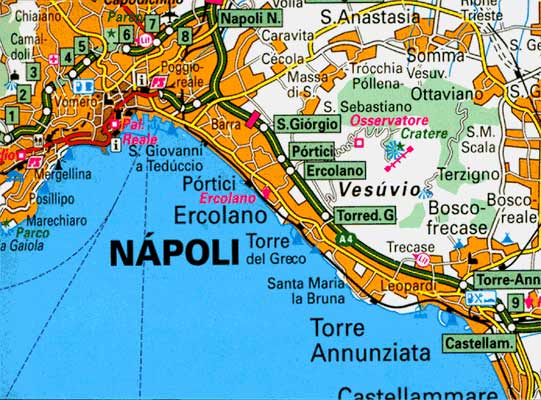
Language, from Naples to the Rio Puerco

I have completed the first week's assignments for a Coursera on line class entitled "Miracles of Human Language: An Introduction to Linguistics".  The free course is sponsored by the University of Leiden in the Netherlands, and is taught by Marc van Oostendorp.  About 35,000 people are participating in the five-week course which is taught in English.  There are many who are students of linguistics and related disciplines and many are teachers.

The timing of the Coursera linguistics course was good for me as I have recently found myself pondering some issues of language which appeared in the course of my reading and later during a tour of some ancient ruins and a ghost town in the Rio Puerco Valley to the northwest of Albuquerque.

cartography-huber.com

I finished reading a trilogy of novels about a week ago by the Italian author, Elena Ferrante, who writes about life in post-war Italy.  The main characters in the three books are two women who are life-long friends engaged in an epic struggle to survive poverty, violence and crushing social constraints in the city of Naples.  A surprising aspect of the story for me was the central role which the author gave to language in the development of her characters.  The community of small shop  owners from which the two women came are portrayed as using the Neapolitan Dialect almost exclusively in their daily life.  Differences in vocabulary, pronunciation and even grammar from standard Italian create difficult communication barriers for the characters, and a concerted effort to overcome those difficulties must be made by the two women to enable their success in the wider academic and business worlds.

Rio Puerco Watershed - usgs.gov

I described my participation in a tour of the Guadalupe Ruins and the near-by ghost town on the bank of the Rio Puerco in a previous post to this blog.  The interpretation of the village ruins was conducted by Nasario Garcia who had lived as a child with his extended family near the town.  I had an opportunity to ask him at the end of his presentation about the languages spoken in those days.  Not surprisingly, he said that in the far-flung small communities of the Rio Puerco Valley, only Spanish was spoken.  Garcia's first real exposure to English came only when he started attending primary school.  Garcia became the first college graduate in his immediate family, but achieving that goal was far from a certainty as he struggled in his first year an UNM to meet the school's language proficiency requirements. He went on from there to earn a PhD and to author over thirty books.  It was an extraordinary experience to hear Garcia recount that long journey as he stood in front of the crumbling adobe remnants of the village of Guadalupe.

Sunday, August 4, 2013

Chile, far and near

Having struggled through a few Cortázar stories recently, I decided to give myself a little break with some contemporary Chilean novelists, Roberto Ampuero, Sebastián Edwards and Alberto Fuguet.

¿QuiĂ©n matĂł a Cristián Kustermann? by Roberto Ampuero was the first in a series of detective stories featuring his character, Cayetano BrulĂ©.  That effort was a great success, translated to many languages, as were his subsequent books.  The style is formulaic 40s/50s noir, with a plot revolving around an over-the-hill detective based in Chile and with roots in the U.S. and Cuba.  I got the light entertainment I was looking for, so I can't really complain.  I would not expect much more from the author, except that he has led an interesting life that has given him a rich source of material.

Ampuero joined the Communist Party as a teenager and soon thereafter had to flee the country after the Pinochet regime came to power in 1973.  He went first to East Germany for a time, and then on to Cuba where he completed his undergraduate work.  More years in Germany led to disillusionment with the institutionalized Left. He pursued graduate studies at the University of Iowa beginning in 2000 and subsequently taught there until recently when he accepted the post of Ambassador to Mexico.  In May, he was appointed by Chile's current right-wing president to be the Minister of Culture.  His tenure in the ministerial position is likely to be short as the left-winger, Michelle Bachelet, seems a shoe-in for the November presidential election.

Un DĂ­a Perfecto is the second novel from Sebastián Edwards, and like his first, El Misterio De Las Tanias, was a best-seller in Chile.  The novels have not yet appeared in English translation, but I will be surprised if they do not soon show up in versions in English and other languages as well.  Much of the first half of Un DĂ­a Perfecto is devoted to a blow-by-blow account of a 1962 soccer match in Arica, Chile, in which Chile unexpectedly bested the Soviet Union.  Having thoroughly disliked popular spectator sports all my life, it came as quite a surprise to me that I could enjoy such a story.  Of course, the match is really just the scaffolding for the development of the characters, but I'm still impressed with Edwards' skill at making the details of the sports event seem compelling.

The story of Un DĂ­a Perfecto is primarily about two brothers and the wife of one who sort out their complicated relationships in the course of the day of the World Cup quarter-final match.  Edwards tells their story in short, punchy chapters which easily sustain interest and curiosity about how the triangular encounter will end.  The sub-plot in the second half about a journalist, a soccer referee and a Soviet player is told with economy too, but not so convincingly, I think.  The referee and the Soviet athlete are characters based on real people who were involved in the 1962 match; I suppose they are introduced to give some historical dimension to the story, but their motivations and actions seem lacking in substance compared to the main characters.

Edwards is a close friend of Roberto Ampuero, but unlike him, Edwards remained in Chile after the Pinochet take-over, and he completed his studies at the Catholic University in Santiago in 1975.  Edwards got his M.A. and Ph.D. in Economics at the University of Chicago and went on to a distinguished academic career, writing many books about economics.  He was also Chief Economist for Latin America and the Caribbean  at the World Bank from 1993 to 1996.  Interestingly, none of that personal history enters into the stories he tells in his novels.  Both of those literary efforts are anchored in the Cold War period, with flash-backs to the WWII era.

Las pelĂ­culas de mi vida by Alberto Fuguet is built around a list of popular U.S. films, mostly from the 1960s and '70s.  The narrator, Beltrán, recalls the times, the events and the people he associates with seeing the films.  It seems like a somewhat slender gimmick for structuring a novel, but it works very well to produce a story that seems more like a real memoir than a made-up fiction.  Much of the book's chronology clearly does have some direct relation to the life of Fuguet who spent his childhood in Los Angeles before being taken back to Chile by his parents when he was about thirteen and Pinochet was a couple years in power.  Just how much his real friends and relatives resembled the book's characters is hard to say, but they all seem very real.  All are pulled in different directions by the complicated economics and politics of the times; the main protagonist spends half a lifetime sorting out both his cultural origins and his relationships to his family.

Fuguet's life followed a trajectory which was the opposite of the two previously discussed authors.  It was not his choice to return to Chile and he held on to his attachment to U.S. popular culture, but at the same time he pursued a full life in his own country, learning the language, growing up and getting and education as a journalist at a time when Chile was under the thumb of a dictator.  Fuguet does not directly deal with the political climate in Chile of that time, but his characters do reflect a rather dismal environment similar to that which was described by the post-war Spanish writers like Laforet and MartĂ­n Gaite (though with a much lighter touch).  Fuguet's style has a marked cinematic quality, and not surprisingly his latest efforts have turned to film making.  In fact he has said: «Nunca quise ser escritor, siempre quise ser cineasta. Y creo que ahora lo logrĂ©».(I never wanted to be a writer; I always wanted to be a film-maker.  And I believe I have now accomplished that.)  I read the 2003 Alfaguara edition.  There is also a 2005 English version from Harper Collins.

Saturday, July 13, 2013

Cotázar

It is now a half century since the publication of Julio Cotázar's most acclaimed work, Rayuela.  Next year will mark the centenary of the author's birth.  All the publicity around these events reminded me that I had never made a serious effort to read Cotázar.  When I complained to a friend that I had always found Cotázar difficult to read, he suggested I try the short stories.

So, I went to the UNM Library and picked up a couple of the collections of short works by Cotázar, Bestiario and Las Armas Secretas.  They turned out to be good choices, with stories from early and later periods of his work.  The Bestiario stories relate strongly to the author's experience of growing up in Buenos Aires, while those in Las Armas Secretas reflect his later life in Paris.  The latter collection includes Las Babas del Diablo, which became the basis for the famous film, Blow-up, about the accidental recording of a crime in a photograph.  As my friend suggested, the short stories are more accessible to someone like me with modest linguistic skills, and I am encouraged to look now at some of the longer works.

I was also inspired to look more deeply into Cotázar's life story, which is quite extraordinary.  He started writing as a very young child, began an early career as a teacher at age eighteen in Argentina, got a scholarship to study in France based on his first novels, became a Unesco interpreter, and produced translations of classic French, German and English literary works.  Cotázar was tremendously productive in his own original creative work throughout his life.  In later life, he lent his talents to supporting liberation movements throughout Latin America.  Of course, he was also an enthusiastic photographer, which also increases his appeal for me.

Luckily for me, the UNM Library has a complete collection of Cotázar's work, as well as a very large selection of the critical and biographical writings about him, many in both Spanish and English.  For instance, there is a copy of a rare and very fine appreciation of Cotázar  published in 2004; it is entitled Cotázar: Presencias.  The book traces out his life year by year through Cotázar's own words, which are interspersed with reminiscences by people who knew him well at different periods in his life.  Cotázar was greatly admired as a writer and as a man by his contemporaries, and the testimonies to that fact in the book nicely fill in the many blanks which are left in a reading dependent solely on what is available on line.

Here is a snippet from the Nicaraguan poet, Claribel Alegría, about Cotázar's third wife, Carol Dunlop (my translation):

"In 1976 Julio met in Montreal Carol Dunlop, a north american girl who had protested against the war in Vietnam.  In one of many demonstrations at the University, the police went after the students with tear gas. Carol decided to go to live in Canada.  Settling in Montreal, she learned French, married, had a son, divorced and refused to speak English.  Many years later Bud (AlegrĂ­a's husband) convinced her not to abandon her mother tongue.  English is so beautiful --he said to her-- and it has nothing to do with the criminals that hounded you.  Finally, she relented.  Julio was happy.  He was much older than Carol but they made a delicious couple.  Carol was a writer and a very good photographer.  They wrote a book together, Los Autonautas de la Cosmopista."

Cotázar was a world traveler and a committed photographer long before he met Dunlop.  One of his trips took him to India where he photographed the 18th Century Jantar Mantar Observatory.  Those photos along with an accompanying poetic text were published in 1972 as Prosa Del Observatorio.  I believe it is his only published photographic work; I have it and am looking forward to reading it after I finish with the short stories.