Having struggled through a few Cortázar stories recently, I decided to give myself a little break with some contemporary Chilean novelists, Roberto Ampuero, Sebastián Edwards and Alberto Fuguet.
¿Quién mató a Cristián Kustermann? by Roberto Ampuero was the first in a series of detective stories featuring his character, Cayetano Brulé. That effort was a great success, translated to many languages, as were his subsequent books. The style is formulaic 40s/50s noir, with a plot revolving around an over-the-hill detective based in Chile and with roots in the U.S. and Cuba. I got the light entertainment I was looking for, so I can't really complain. I would not expect much more from the author, except that he has led an interesting life that has given him a rich source of material.
Ampuero joined the Communist Party as a teenager and soon thereafter had to flee the country after the Pinochet regime came to power in 1973. He went first to East Germany for a time, and then on to Cuba where he completed his undergraduate work. More years in Germany led to disillusionment with the institutionalized Left. He pursued graduate studies at the University of Iowa beginning in 2000 and subsequently taught there until recently when he accepted the post of Ambassador to Mexico. In May, he was appointed by Chile's current right-wing president to be the Minister of Culture. His tenure in the ministerial position is likely to be short as the left-winger, Michelle Bachelet, seems a shoe-in for the November presidential election.
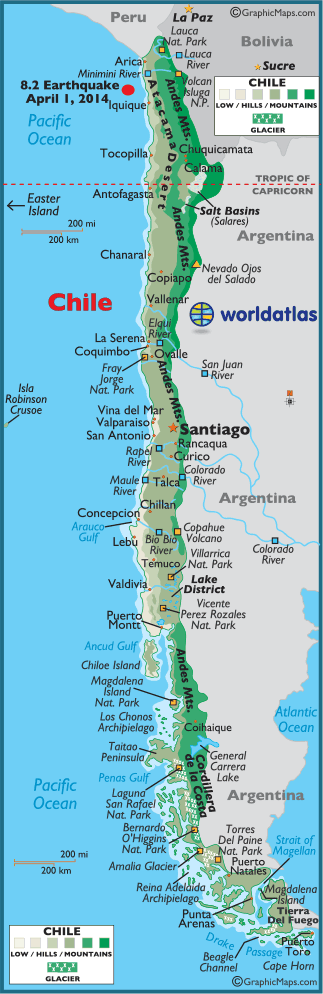
Un Día Perfecto is the second novel from Sebastián Edwards, and like his first, El Misterio De Las Tanias, was a best-seller in Chile. The novels have not yet appeared in English translation, but I will be surprised if they do not soon show up in versions in English and other languages as well. Much of the first half of Un Día Perfecto is devoted to a blow-by-blow account of a 1962 soccer match in Arica, Chile, in which Chile unexpectedly bested the Soviet Union. Having thoroughly disliked popular spectator sports all my life, it came as quite a surprise to me that I could enjoy such a story. Of course, the match is really just the scaffolding for the development of the characters, but I'm still impressed with Edwards' skill at making the details of the sports event seem compelling.
The story of Un Día Perfecto is primarily about two brothers and the wife of one who sort out their complicated relationships in the course of the day of the World Cup quarter-final match. Edwards tells their story in short, punchy chapters which easily sustain interest and curiosity about how the triangular encounter will end. The sub-plot in the second half about a journalist, a soccer referee and a Soviet player is told with economy too, but not so convincingly, I think. The referee and the Soviet athlete are characters based on real people who were involved in the 1962 match; I suppose they are introduced to give some historical dimension to the story, but their motivations and actions seem lacking in substance compared to the main characters.
Edwards is a close friend of Roberto Ampuero, but unlike him, Edwards remained in Chile after the Pinochet take-over, and he completed his studies at the Catholic University in Santiago in 1975. Edwards got his M.A. and Ph.D. in Economics at the University of Chicago and went on to a distinguished academic career, writing many books about economics. He was also Chief Economist for Latin America and the Caribbean at the World Bank from 1993 to 1996. Interestingly, none of that personal history enters into the stories he tells in his novels. Both of those literary efforts are anchored in the Cold War period, with flash-backs to the WWII era.
Las películas de mi vida by Alberto Fuguet is built around a list of popular U.S. films, mostly from the 1960s and '70s. The narrator, Beltrán, recalls the times, the events and the people he associates with seeing the films. It seems like a somewhat slender gimmick for structuring a novel, but it works very well to produce a story that seems more like a real memoir than a made-up fiction. Much of the book's chronology clearly does have some direct relation to the life of Fuguet who spent his childhood in Los Angeles before being taken back to Chile by his parents when he was about thirteen and Pinochet was a couple years in power. Just how much his real friends and relatives resembled the book's characters is hard to say, but they all seem very real. All are pulled in different directions by the complicated economics and politics of the times; the main protagonist spends half a lifetime sorting out both his cultural origins and his relationships to his family.
Fuguet's life followed a trajectory which was the opposite of the two previously discussed authors. It was not his choice to return to Chile and he held on to his attachment to U.S. popular culture, but at the same time he pursued a full life in his own country, learning the language, growing up and getting and education as a journalist at a time when Chile was under the thumb of a dictator. Fuguet does not directly deal with the political climate in Chile of that time, but his characters do reflect a rather dismal environment similar to that which was described by the post-war Spanish writers like Laforet and Martín Gaite (though with a much lighter touch). Fuguet's style has a marked cinematic quality, and not surprisingly his latest efforts have turned to film making. In fact he has said: «Nunca quise ser escritor, siempre quise ser cineasta. Y creo que ahora lo logré».(
I never wanted to be a writer; I always wanted to be a film-maker. And I believe I have now accomplished that.) I read the 2003 Alfaguara edition. There is also a 2005 English version from Harper Collins.