DISARM ICE --- LET THE POLICE CATCH REAL CRIMINALS --- DEMAND ACCOUNTABILITY --- KEEP AMERICA SAFE FOR EVERYONE ---
Showing posts with label Rio Puerco. Show all posts

Saturday, April 4, 2015

Language, from Naples to the Rio Puerco

I have completed the first week's assignments for a Coursera on line class entitled "Miracles of Human Language: An Introduction to Linguistics".  The free course is sponsored by the University of Leiden in the Netherlands, and is taught by Marc van Oostendorp.  About 35,000 people are participating in the five-week course which is taught in English.  There are many who are students of linguistics and related disciplines and many are teachers.

The timing of the Coursera linguistics course was good for me as I have recently found myself pondering some issues of language which appeared in the course of my reading and later during a tour of some ancient ruins and a ghost town in the Rio Puerco Valley to the northwest of Albuquerque.
cartography-huber.com

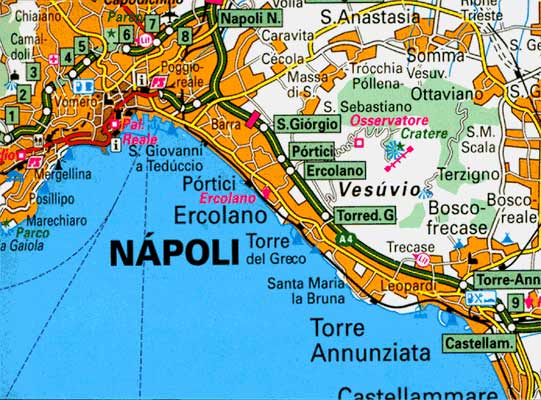
I finished reading a trilogy of novels about a week ago by the Italian author, Elena Ferrante, who writes about life in post-war Italy.  The main characters in the three books are two women who are life-long friends engaged in an epic struggle to survive poverty, violence and crushing social constraints in the city of Naples.  A surprising aspect of the story for me was the central role which the author gave to language in the development of her characters.  The community of small shop  owners from which the two women came are portrayed as using the Neapolitan Dialect almost exclusively in their daily life.  Differences in vocabulary, pronunciation and even grammar from standard Italian create difficult communication barriers for the characters, and a concerted effort to overcome those difficulties must be made by the two women to enable their success in the wider academic and business worlds.

Rio Puerco Watershed - usgs.gov

I described my participation in a tour of the Guadalupe Ruins and the near-by ghost town on the bank of the Rio Puerco in a previous post to this blog.  The interpretation of the village ruins was conducted by Nasario Garcia who had lived as a child with his extended family near the town.  I had an opportunity to ask him at the end of his presentation about the languages spoken in those days.  Not surprisingly, he said that in the far-flung small communities of the Rio Puerco Valley, only Spanish was spoken.  Garcia's first real exposure to English came only when he started attending primary school.  Garcia became the first college graduate in his immediate family, but achieving that goal was far from a certainty as he struggled in his first year an UNM to meet the school's language proficiency requirements. He went on from there to earn a PhD and to author over thirty books.  It was an extraordinary experience to hear Garcia recount that long journey as he stood in front of the crumbling adobe remnants of the village of Guadalupe.

Monday, March 30, 2015

Guadalupe Ruins

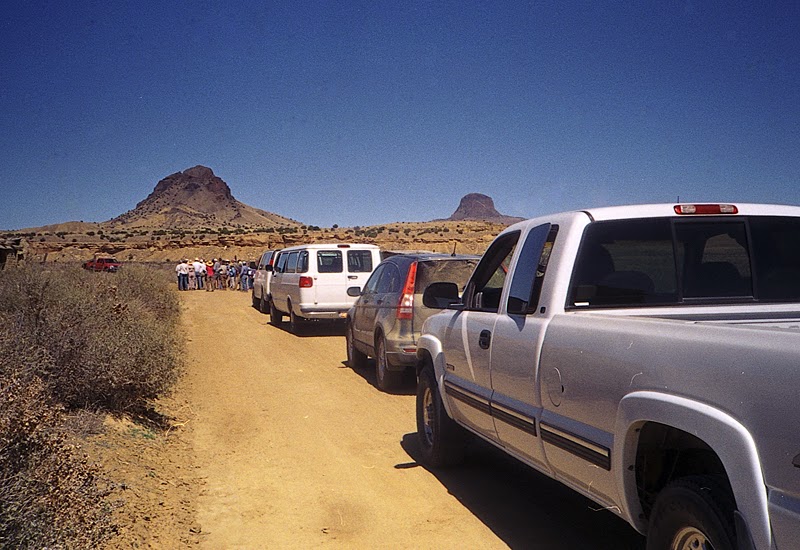
I visited the Guadalupe Ruins west of Cuba, New Mexico with a group assembled by Mary Beth Hermans at the UNM Maxwell Museum of Anthropology.  The ruins are located on top of a small mesa south of Cabezon Peak.


The remaining low walls of the residential structures show masonry construction techniques which will be familiar to anyone who has visited the ruins at Chaco Canyon.


Two fairly large kivas have been excavated and roofed with corrugated metal sheets.


The kivas would orginally have had large log beams holding up the roof, but no trace of them remains.


There were about two dozen people in the group, all about my age, and all rather fit and well-informed about the archaeological context of the site.


Tom Windes provided a running commentary on the site as we toured it.  He had done extensive survey work at Chaco and was able to provide good insights into the way that the Guadalupe site fit into the bigger picture of the pre-puebloan culture.  This mesa location was originally occupied around 900 AD by the Anasazi.  It probably saw numerous abandonments and reoccupations due to the rigors of the climate.  The last residents came to the site around 1200 AD as migrants from Mesa Verde.  There are many largely unexplored house sites on the flats below the mesa.


On the way back out we stopped for a quick tour of the near-by ghost town of Guadalupe.  The site was first occupied by hispanic settlers around 1760.  That settlement may have been temporarily abandoned  due to pressure from the Navajo and Apache.  A second phase of hispanic settlement started up about 1860 and the little town remained viable into the 1940s.


Nasario Garcia lived as a child in a house just across the Rio Puerco from Guadalupe.  He has endless stories about the place and its residents which he has incorporated into about thirty books.


The town is still owned privately and there is some restoration work going on there, though it seems unlikely it will ever regain any of its former vitality.