DISARM ICE --- LET THE POLICE CATCH REAL CRIMINALS --- DEMAND ACCOUNTABILITY --- KEEP AMERICA SAFE FOR EVERYONE ---
Showing posts with label 3D. Show all posts

Friday, June 13, 2025

My New Trike


 When I first tried out this three-wheeler I was surprised to find I could not seem to steer it.  When I put pressure on the peddles the thing just wanted to turn sharply.  It baffled me as I had been riding bicycles all my life until I started falling off because of weakness due to tendon injuries.

I found a youtube video of a fellow demonstrating how to ride.  I saw that he had a very upright posture and he was steering with just two fingers.  That encouraged me to try again following his example.  I also found that pushing the handlebar on the side opposite the desired turn direction was a better technique.  Once I was able to get myself up and down the street, the process began to seem more natural and intuitive.

 The Old Trike

I played around with 3D drawing programs about twenty years ago and one of my first efforts was to reconstruct my memory of my first trike in the mid-1940s.  I don't recall any difficulty in learning to ride this one.  Kids seem to take to the task with no problem.

Happy trails!

Tuesday, October 11, 2016

3D On Line

I started playing around with 3D drawing nearly ten years ago using the SketchUp program when it still belonged to Google. I devoted about a year to learning the program and produced quite a few 3D models, some of which can be viewed by clicking the link to my 3D Warehouse folder over in the right column.


(Left click for 3D interaction.  Model loads slowly.  Hold down center mouse button to drag and move model.)

Trimble, Inc. took over the program and made quite a few additions and improvements to it.  Now, they have made an on line beta version available.  It is surprisingly responsive, and fun to play with.

Saturday, November 16, 2013

Smithsonian X3D


The Smithsonian has initiated the X3D viewer, accessible via the web, to display 3D models of specimens from its collection of 137 million objects.  The viewer was developed by Autodesk and its operation will look familiar to anyone who has played with 3D drawing software.  The model may be manipulated and zoomed with the mouse controls, and the viewer also permits custom view settings including light controls.

The source images for the digital models are produced by drawing, laser scanning, photogrammetry and micro-ct scans.  In addition to making the images available through a web brower, there is also a possibility of supplying files in formats permitting the production of solid models with a 3D printer.

The Smithsonian site contains interactive models, and explanatory videos showing the digitization techniques and brief lectures about the potential of the idea for educational outreach.  There is also a conference planned for November which will be streamed live from the web site.
-------------
update:
The X3D application is pretty resource intensive.  One of our home computers is an older Dell running XP, and it really cannot even support a small iframe running the the Autodesk viewer.  My Dell Precision 690 has more RAM and a faster CPU which does ok with X3D.  I'm wondering how people with tablets and similar platforms are doing with this technology.

Friday, July 12, 2013

3D

There is something quite magical about the illusion of 3D which can be produced in a 2D space.  A big step toward the portrayal of scenes which seem to mimic reality was taken with the discovery of the techniques of liner perspective in the 14th Century.  That breakthrough may have gotten a boost from technology in the form of the camera obscura which projected an image onto a flat plane, thus revealing spatial relationships in a very transparent manner.


The invention of photography early in the 19th Century incorporated advances in optics and chemistry to allow the instantaneous fixation of the camera obscura's image.  That technological breakthrough did not spell the instant doom of the arts of painting a drawing as was initially feared, but it did take over those aspects of image making concerned primarily with the accurate portrayal of scenes and objects where fidelity of detail and perspective was of utmost importance.
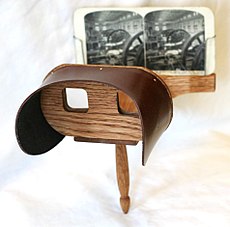

The production of 3D (stereoscopic) photographic images began very soon after photography was invented, and by the end of the 19th Century there was a huge market for 3D photographic imagery produced with double lens cameras and viewed with simple hand-held binocular devices which allowed the optical fusing of two images into a single photographic representation with a startling illusion of depth.  Most such images were produced and consumed for their educational and entertainment values.  However, there were also some practical and scientific benefits flowing from the technology such as in its use in aerial photography.


With 3D graphics, this NOVA film reveals how the Allies used
special aerial photos to deal a dire blow to the Nazi rocket program

Moving images in 3D color hit the big screen with a splash in the 1950s.  Audiences were equipped with cardboard-framed glasses with polarized plastic lenses which merged the images from two projectors which seemed to thrust viewers into the midst of the action.  In the films coming out of the 3D studios of that era, the novelty factor generally outstripped other production and literary values.  Projection quality was difficult to maintain given the state of the technology, and interest in producing and viewing 3D films nosedived after a couple years of this first big Hollywood effort in the stereographic realm.

The development of 3D moving pictures continued on after the 1950's in specialized venues such as those provided by IMAX and Disney presentations in the 1980s and 1990s.  By the beginning of the 21st Century, the industry started to ramp up again with many new productions taking advantage of advances in computer technology and digital image processing.  The highpoint of this latest phase was realized in 2009 with the release of the science fiction film, Avatar.  While that film was wildly successful, the industry soon took a downward turn again, possibly in a large part due to the world-wide economic collapse.  A parallel effort to bring 3D technology into home video presentations also began to fizzle at the same time.

While 3D in entertainment venues has thus experienced what seems to be one of its regular downturns, other 3D applications are still being developed at a great rate, with big and small players exploiting the fact that computer processing capacity continues to come close to obeying the Moore's Law doubling prediction every two years.  The big successes have been registered by applications with everyday utility like the on-line 3D maps provided by Google which offer vast, detailed coverage along with putting complete interactive control into users' hands.


 3D modelling in design applications got a big boost from computer advancements which was initially capitalized on by big software companies like Autodesk.  Google also got in on the act for a time with its 3D drawing program, Sketchup.  However, it is noteworthy that Google recently sold off Sketchup to Trimble.  That step away from this area of 3D image production may indicate a recognition of the fact that automated image capture and processing capabilities have caught up to older laborious manual processes and which can now produce 3D imagery very quickly and with a considerable level of sophistication.

Google's support of the Sketchup 3D modeling program was mainly aimed at giving a tool to a vast army of volunteers for producing 3D models of buildings which could be incorporated into Google Maps and Google Earth.  Now, however, some small start-ups have demonstrated the possibility of producing very good 3D architectural models using camera-equipped drones and image-processing algorithms which can produce good models in a fraction of the time required by older manual drawing programs.  It is not hard to imagine that Google may be considering the possibility of augmenting its fleet of camera-wielding mapping vehicles with airborne drones.

The convergence of computer technology from a variety of sources is also leading to the emergence of a new  level of 3D technology which goes beyond the representation of 3D images in 2D space to the actual fabrication of solid objects from scanned imagery.  One demonstration of this new technology has been recently demonstrated by a German company Twinkind in Hamburg which has built a multi-camera photo booth that can create a composite image of an individual in an instant, and then produce a foot-high exact likeness of the person with a 3D printer.  That may be just an expensive novelty item right now, but it points to the possibilities of using similar techniques in manufacturing which hold great promise, not only in rapid prototyping, but also for actual production.


Saturday, February 18, 2012

The parts assembled


This is my rendition of a Sixteenth Century stonebow, modeled in the free version of Google Sketchup.  It resembles an illustration in the Payne-Gallwey book on crossbows.  I had to wing it in a few details because of my skill limits in the program.  I also found that some of the parts from the plans shown by the author did not fit together well; some may have been from different models judging by the proportional errors.  I'm also  not sure of some of the mechanical details.  For instance, I haven't yet come across an explanation of the proper relationship between the bow and the stock which allowed the bullet to pass over the end of the stock without hitting it.  I ended up giving my bow a bit of dihedral, but I doubt that was the actual bowyer's solution.

Being able to manipulate a 3D model on my computer screen was something I wanted to do ever since I saw the first examples of it on some of the early personal computers.  I'm happy to stop at that.  Others who use Sketchup and similar programs go the extra step of translating the images into real-world objects.  Aircraft modelers typically print out cross-sections of their creations to use as patterns to be cut from plastic foam.  More recently, designers are producing complex models and prototypes directly from the computer designs using 3D printers.

Tuesday, February 14, 2012

Lost Love

I seem to have drifted back into Sketchup. I'm not quite sure what got me started on modeling a Sixteenth Century stonebow. I've got most of the parts sketched out with the exception of the bow, which will probably be the most difficult component.


When we moved to the city I decided to give away all my archery gear, including a fine little book by Saxton Pope on the rediscovery of the joys of making and using the longbow.  I had a couple recurves and an old longbow which I never strung or shot.  I never did own a crossbow, though I was always interested in them.  I recall that the De Young museum in San Francisco had a nice example of a stonebow very similar to the one I'm working on now in Sketchup.

The illustrations and plans I'm working from are out of The Book of the Crossbow by Ralph Payne-Gallwey.

Saturday, February 4, 2012

me262

The Germans fielded the first operational jet fighter in WWII, the me262.  


This model was constructed in OpenVSP.  I've learned a few more things about using the program, but still don't understand how one might round off the wingtips, nor how to properly shape the cross-sections.  I used a POD object to form the canopy; it gives a smoother result than the FUSE object, but no individual cross-section control. Perhaps I'll try this same model in Sketchup.

Thursday, January 26, 2012

MiG-15

More doodling with OpenVSP.


This is a rather crude rendering of the mid-century Soviet fighter.  I still haven't figured out how to do cross-sections which would create a canopy, so I approximated one using a short fuselage object.  It also isn't clear to me how one might round off the tips on the wings and tail surfaces.  I'll work out the answers to some of my questions with practice, but it would be nice to see how others are dealing with some of the challenges.

Wednesday, January 25, 2012

OpenVSP

I put away my 3D drawing projects for some time because of a combination of frustration with the complexity of the tools and the nagging thought that they were taking too much time away from my photography.  Recently, I have been seduced into the 3D world again by the appearance of a new tool, OpenVSP.   As the NASA web site says:

OpenVSP is a parametric aircraft geometry tool. OpenVSP allows the user to create a 3D model of an aircraft defined by common engineering parameters. 

Compared to anything else I've tried, OpenVSP is blazingly fast, and * taa-daa * it's free.

Here is an example design that comes with the program showing its capabilities:


Here are  several doodles I produced in a few minutes each:


Here's my x-plane that I've been using to familiarize myself with the program's drawing tools:


There is a very good manual for OpenVSP which includes instructions on all the basics and a few ok video tutorials.  To get beyond the basics takes some dedication; I'm trying to figure out at the moment how to construct a typical aircraft coss-section which inludes a canopy.  Hopefully, there will be some online discussion developing around the program which will help to answer questions.  Since NASA has released the program as Open Source, perhaps there will also be some development of additional features and import/export options.

Sunday, August 22, 2010

Wednesday, July 14, 2010

Chapter 2


(Write your own caption.)

Tuesday, July 13, 2010

lonely penguin


I'm slowly working my way through the Blender tutorials. My models never look quite like the examples, but they are close enough so that I feel I'm making some progress.

Friday, July 9, 2010

Meeting Suzanne

Suzanne is the iconic mascot of the Blender 3D drawing program.


I thought I should give the program a try; it is open-source and free. Blender has built-in animation and rendering capabilities. More importantly for me, it is capable of producing organic designs which are hard to achieve in Google's SketchUp. I've had fun so far learning a bit about the user interface, and tinkering with the controls. Whether the program can be mastered by the average 70-year-old is something that remains to be seen.

Monday, June 7, 2010

3D Art

Came across a link to this 3D animation this morning at the Filmwasters site.
Pretty extraordinary work.


If you look at the Youtube page, there are a number of similar videos listed in the righthand column, many done by UC Berkeley students. I've been wondering how 3D design is being approached in schools, so was pleased to find these examples. According to the Filmwasters post, the Brownie Hawkeye Flash was done in Solidworks.

Thursday, May 13, 2010

learning...

This is one of Howard Hughes' racers from the '30s. The errors are cumulative, so I probably won't continue working on this one. I'll just haul it out behind the garage where it will be out of sight.


One thing I've discovered from this first aircraft model is the importance of having a good plan to work from. I only had a small .gif 3-view for the Hughes plane, so it was difficult to render forms with any precision. I have a much better plan for a similar racer from the same era now, so we'll see how that goes.

Sunday, May 9, 2010

Mothers' Day Flyover


I'll add a version of this to my wallpaper download page shortly.

Monday, April 19, 2010

not yet an airplane

But I'm getting better with the tools, thanks largely to the Google SketchUp 7 for Dummies book. I haven't quite figured out the components feature yet, and I need some practice making more organic forms. Fun stuff.


The model of the Kodak Brownie Reflex may be viewed and downloaded from the Google 3D Warehouse

Wednesday, April 14, 2010

two views

These two images of the house we live in were made recently using tools which are quite widely spaced on the imaging technology spectrum. The photograph is from my Argus AF, one of the first American-made 35mm cameras which dates from 1937.


The drawing is a screen capture from Google's SketchUp 3D rendering program. I don't know if I'll achieve the skill level needed to produce something as complex as an aircraft design, but I'm pretty happy to have gotten this far with the program.


The SketchUp program is free for downloading, and Google also maintains an on line warehouse of images produced by users with impressive talent and skills.


The program has become the tool of choice for all kinds of model design. 3D building representations are being used to construct on line cities in Google Earth. Card modeling designers build aircraft in computer space and then use another program to unfold the surfaces for assembly. The computer generated designs can also be directly translated to real-world objects using 3D printers or computer-directed milling machines such as the one illustrated in this Daishin YouTube video.