--- THE DEATH PENALTY IS A BARBARIC RELIC ---

Friday, June 12, 2015

geeky diversion

The 5-dollar price tag on this old Dell laptop caught my eye while I was browsing in the back room of the local thrift shop.  


The computer, a Dell Latitude CSx, had a power supply with it, so I plugged it into a wall outlet and was surprised to see the screen light up with Windows 2000.  At that price I just couldn't pass it up.


A few problems presented when I got my find home.  The first being that there was a log-in screen demanding an unknown password.  I figured I could get by that via the set-up utility accessed by pressing the F-8 function key as the computer is in the bootup stage.  Except that there was a diagonal row of keys that did not work, including the F-8 key.  So, another trip to another thrift store where I picked up a 2-dollar keyboard with a PS2 connector.  That let me get at the setup screen and I was able to set a new Administrator password and get myself into Windows 2000.


So far, so good, but it's awkward to carry around a full-size desktop keyboard along with a laptop.  I opened up the case to get at the keyboard and found that the keys were a very simple mechanical type which did not appear to have anything wrong with them.  In fact, I found that just lifting the keyboard slightly restored the full functioning of all the keys, so it was clear that the problem was with the ribbon cable connecting the keyboard to the main board.  A small paper shim tightened the connector on the keyboard-end of the cable and I was back in business with Windows 2000 running on a Pentium III.  Wow!


Dell's approach was to market a basic machine with peripherals and accessories that attached via external connectors.  Luckily, mine came with a card with a pop-out ethernet connector.  I am also able to attach a wifi adapter with the single usb port on the back.


A Pentium III processor and 256K of RAM is a pretty minimal machine these days for any kind of on-line work.  The current version of Google's Chrome browser will not run on such a set-up, but Firefox works ok and an older version of Opera is even a little quicker.  Looking back fifteen years, however, this was a pretty nice little machine at the time.  The Microsoft Office applications including Word all work fine and would have been perfectly adequate in a transitional business environment in which producing end-user paper copy was still the dominant paradigm. Windows 2000 was a product of Microsoft's NT system which was really a revolutionary step forward, providing the basis for much of what we can do today with personal computers.  I doubt I'll actually get a lot of use from this old laptop, but I got at least five bucks of fun from restoring it, and it provided a good opportunity to look back fifteen years to near the beginnings of the digital revolution.

******
The Dell Latitude just has one slot for RAM and I believe that the max it could take was 512K.  I'll keep my eyes open for the 512 replacement for my 256K so I can see how much of a difference that would yield in performance.  I have an old Compaq Evo N600c with similar specs and it does very well on the web with a gig of RAM and running Windows XP.

Friday, June 5, 2015

Killer Heels

No one who has met me would mistake me for a fashionista.  However, I really liked the current show at the Albuquerque Museum, Killer Heels: The Art of the High-Heeled Shoe.


Saturday, April 18, 2015

All dressed up for the 308th Birthday Party

...of Albuquerque.  The car dates from somewhere in the 1940s.


The city's Old Town was full of people enjoying the festivities which included Native American and Flamenco Dancers, music from all over and, of course, a car show.

Friday, April 17, 2015

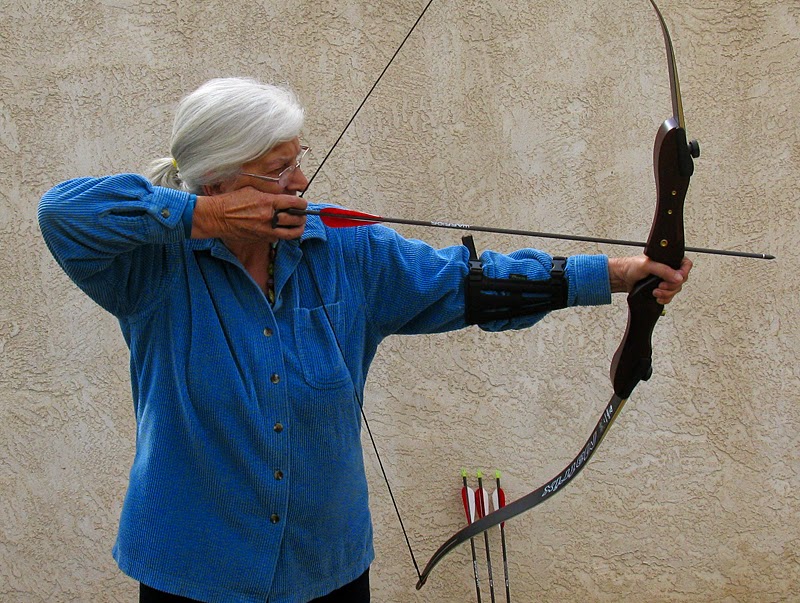
archer

Margaret has made great progress with the bow.  


I'm going to have to work hard to catch up with her.  I did some damage to my bow shoulder by shooting a bow that was a bit too heavy.  I got some lighter weight limbs for our take-down bow, but I need a week or two more before I start shooting again.

Thursday, April 16, 2015

Albuquerque's Pride

The baby hippo was born on April 14, 2015.


Friday, April 10, 2015

Language Proficiency; Making the Right Moves


I have completed the second week of the Coursera on line linguistics course.  I am pleased to say that the course has already provided me with some answers to questions I have had about language acquisition and proficiency.  Of course, there also have been answers to questions which had not previously occurred to me.  The exercises in the fundamentals of phonetics, for instance, gave me some insights into how consonant and vowel formation actually takes place and how it can be systematically analysed.

In the end of the week wrap-up video the professor, Marc van Oostendorp, gave a glimpse into the course's demographics.  About 42,000 participants from 190 countries are now engaged in studying the basics of linguistics.  The email referring to participation mentioned that it would be revealed in the video what was the age of the youngest and oldest students.  I approached that revelation with some trepidation as there was a possibility that I might be the oldest.  In fact, while I am certainly located in the narrow right tail of the age distribution curve, the honor for oldest went to "Margaret", an eighty-year-old South African.  The youngest course participant turned out to be just fourteen years old and a resident of India.  It would be interesting to see more on the statistical profile of the student body; I'm sure the U. of Leiden will be paying close attention to those numbers.

Participation in the linguistics course has provided me with the opportunity to reflect on my own struggle to attain some proficiency in Spanish as a second language.  On the one hand, it is a little dispiriting to observe that a life-time of study and practice has not resulted in anything close to perfection.  At the same time, I am encouraged by the fact that I seem to have made some progress over the past couple of years.  I am reading more challenging books than I was comfortable with previously and I feel that my comprehension has improved.  It seems unlikely given the state of my memory that any improvement is due to vocabulary enhancement.  Rather, I would attribute my perceived gains more to some improvement in attention and engagement.

I have found that making a conscious effort to focus on the meaning of the text I am reading actually pays off.  I tested this idea recently by going to the UNM library and sitting down to read a short story by a writer who was new to me, Mercè Rodoreda.  While I did not have the crutch of the Kindle translation dictionary and did not consult a dictionary in book form, I was able to follow the story line without great difficulty just by taking my time to absorb the writer's intent.  Given those encouraging results I went on line and ordered a copy of the author's best-known novel, La Plaza Del Diamante.

At the other end of the spectrum from me is that fourteen-year-old Indian kid.  He is taking a college-level course taught in English, just one of several languages he speaks.  Those facts highlight the well-known capacity to absorb languages at an early age, which seems to atrophy as we get older.  Receptivity to language acquisition is likely based in part on pattern recognition capacity, and that may well extend to other areas of learning as well.  For instance, I am thinking of a news item I saw recently about the chess grandmaster, Sam Sevian, who attained his title at the age of thirteen.  As seems to have been the case with many other chess greats, Sevian was introduced to the game by his father before he was old enough to start school.  There may be a genetic component to Sevin's success in chess given his father's expertise in the game, but it also seems possible that missing that early opportunity to be exposed to the game could have closed the window on achieving the extraordinary potential which was initially available.

Sunday, April 5, 2015

Ferrante x2

I wrote the following commentary about Elena Ferrante's novels and some additional thoughts about language in Italy and Spain while participating in a group of Spanish language enthusiasts which meets weekly at CNM in Albuquerque.  Scroll down the page for the Spanish version.


***

I am reading an Italian author, Elena Ferrante, and have just about finished the first in a series of books she wrote about the friendship of two women in Naples which began in the 1950s.  Ferrante's style and subject matter show some resemblance to the earlier work of Elsa Morante, and it turns out that Ferrante is an admirerer of that older writer, famous for her depictions of the rigors of life in post-war Italy.  With no fluency in Italian I have chosen to read the Italian authors in Spanish translation as that seems likely to be closer to the spirit of the originals than English versions.

Reading Ferrante at this time has given me the opportunity to think about the similarities and differences in the experiences of Italians and Spaniards in the war-time and post-war years regarding history, politics and linguistics.  Ferrante often refers in her writing to the use of the Neapolitan Dialect by her characters who are all members of struggling families of small business owners.  In the early post-war period, there was little access to educational opportunities for most Italians and many in Naples spoke only the local dialect and had great difficulty expressing themselves in standard Italian.  Today, with better access to education and wider media exposure, there are likely more Neapolitans who are comfortable in the national language of Italy, but the use of the popular dialect still continues to be of importance in daily life.  Unlike Spain, however, the historic linguistic diversity of Italy does not seem to have supported the development of robust regional nationalisms as is the case in Cataluna or in the Basque region.

Spain and Italy had somewhat parallel historic and political trajectories during the 1930s and 1940s and before, which accounts for some similaries in linguistic diversity.  The expression of that diversity, however, seems to have taken different paths toward the end of WWII.  Italy experienced a much more intrusive German influence during the war years than did Spain, but then that disappeared along with the dominance of the Fascists with the triumph of the Allies.  Democratic political forms were allowed room to develop in Italy along with a resurgence of leftist parties and some more wide-spread economic opportunities.  In Spain, the fascist dictatorship and economic stagnation dragged on for decades after WWII and included the active suppression of minority linguistic groups.  When the Falangists finally lost their grip on the county, ethnic and linguistic identities became rallying points for the development of regional nationalisms.  In Italy, by contrast, linguistic diversity seemed to survive more as an issue of economic class than as an indicator of political affiliation.  Ferrante indicates in her stories of Naples that Communits and Fascists lived side by side  and all spoke in the same Neapolitan dialect.

My knowledge of Mediterranean history is very shallow, so I am sure there are many errors and omissions in what I have written above about Italy and Spain.  I look forward to attempting to rectify my ignorance by further following the trail marked out by Ferrante, as well as delving into some actual historical narratives on these interesting subjects.

***

Estoy leyendo la autora italiana, Elena Ferrante, y casi he acabado con el primero de una serie de libros escrito por ella que trata de la amistad de dos mujeres en Nápoles que empezó en los años cincuenta.  El estilo literario y el contenido muestran una semblanza a la obra literaria anterior de Elsa Morante, y resulta que Ferrante es admiradora de aquella escritora mas madura, famosa por sus representaciones de los rigores de la vida en la Italia de la posguerra.  Sin fluidez en el idioma italiano, he elegido leer los autores italianos mediante las traducciones castellanas porque me parece probable que las versiones castellanas están mas cercas al espíritu original que las traducciones ingleses.

Leyendo Ferrante en este momento me ha dado la oportunidad de pensar en las similitudes y diferencias en las experiencias de los italianos y los españoles durante la Segunda Guerra y en los años de la posguerra en cuanto a la historia, la politica y la lingüística.  Ferrante a menudo se refiere en su escrito al uso del dialecto napolitano por los personajes de sus cuentos, todos miembros de familias quienes son propietarios de pequeñas empresas.  En los primeros años de la posguerra había poco acceso a las oportunidades educativas por la mayoría italiana y muchos napolitanos sólo hablaban el dialecto local y tuvieron gran dificultad para expresarse en italiano estándar.  Hoy día, con mejor acceso educativo y también a los medios de comunicación hay probablemente más napolitanos que se sienten cómodos en el idioma nacional de Italia.  Sin embargo, el empleo del dialecto popular sigue importante en la vida diaria.  A diferencia de España la diversidad lingüística histórica de Italia no ha impulsado nacionalismos regionales sólidos como es el caso en Cataluña o en el País Vasco.

España e Italia tuvieron trayectorias históricas y políticas tanto paralelas durante los años de 1930 hasta 1945 y antes, lo cual explica algunas similitudes en la diversidad lingüística.  La expresión de esta diversidad, sin embargo, parece haber tomado diferentes caminos hacia el final de la Segunda Guerra Mundial.  Italia experimentó una influencia alemana mucho más intruso durante los años de guerra que hizo España, pero después esa influencia desapareció junto con el dominio fascista y la llegada del triunfo aliado.  Las formas políticas democráticas se desarollaron en Italia después de la terminación de la guerra y los partidos izquierdistas ganaron terreno, mientras que mejoraba la situación económica con la ayuda del Marshall Plan.  En España, la dictadura fascista y el estancamiento económico se prolongaron durante décadas después de la Segunda Guerra Mundial y se incluyen la supresión activa de los grupos lingüísticos minoritarios.  Cuando los falangistas finalmente perdieron su control sobre el país, las identidades étnicas y lingüísticas se convirtieron en puntos de reunión para el desarrollo de los nacionalismos regionales.  En Italia, por el contrario, la diversidad lingüística parecía sobrevivir más como una cuestión de clase económica que como un indicador de la afiliación política.  Ferrante indica en sus historias de Nápoles que los comunistas y fascistas vivían lado a lado y todos hablaban en el mismo dialecto napolitano.

Mi conocimiento de la historia del mundo Mediterráneo es muy poco profundo, así que estoy seguro de que hay muchos errores y omisiones en lo que he escrito sobre Italia y España.  Espero rectificar mi ignorancia siguiendo el rastro marcado por Ferrante, y también consultando relatos históricos sobre estos temas interesantes.