--- THE DEATH PENALTY IS A BARBARIC RELIC ---

Saturday, April 4, 2015

Language, from Naples to the Rio Puerco

I have completed the first week's assignments for a Coursera on line class entitled "Miracles of Human Language: An Introduction to Linguistics".  The free course is sponsored by the University of Leiden in the Netherlands, and is taught by Marc van Oostendorp.  About 35,000 people are participating in the five-week course which is taught in English.  There are many who are students of linguistics and related disciplines and many are teachers.

The timing of the Coursera linguistics course was good for me as I have recently found myself pondering some issues of language which appeared in the course of my reading and later during a tour of some ancient ruins and a ghost town in the Rio Puerco Valley to the northwest of Albuquerque.

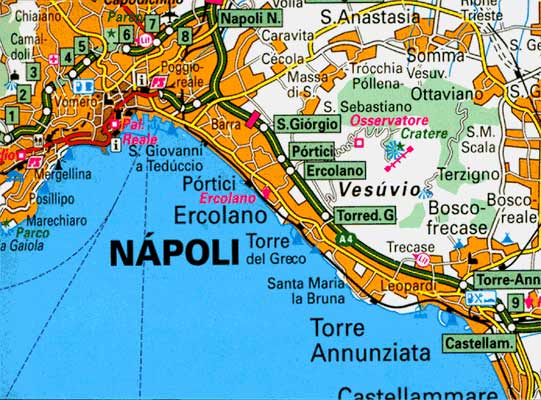
cartography-huber.com

I finished reading a trilogy of novels about a week ago by the Italian author, Elena Ferrante, who writes about life in post-war Italy.  The main characters in the three books are two women who are life-long friends engaged in an epic struggle to survive poverty, violence and crushing social constraints in the city of Naples.  A surprising aspect of the story for me was the central role which the author gave to language in the development of her characters.  The community of small shop  owners from which the two women came are portrayed as using the Neapolitan Dialect almost exclusively in their daily life.  Differences in vocabulary, pronunciation and even grammar from standard Italian create difficult communication barriers for the characters, and a concerted effort to overcome those difficulties must be made by the two women to enable their success in the wider academic and business worlds.

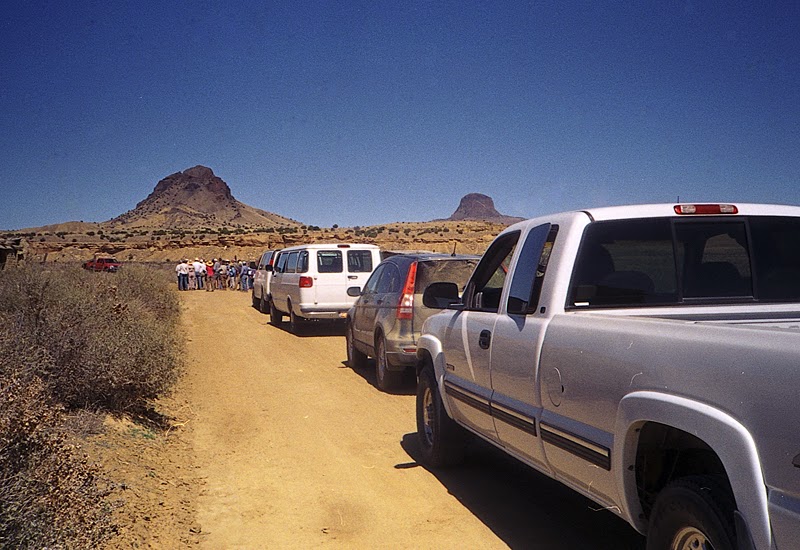
Rio Puerco Watershed - usgs.gov

I described my participation in a tour of the Guadalupe Ruins and the near-by ghost town on the bank of the Rio Puerco in a previous post to this blog.  The interpretation of the village ruins was conducted by Nasario Garcia who had lived as a child with his extended family near the town.  I had an opportunity to ask him at the end of his presentation about the languages spoken in those days.  Not surprisingly, he said that in the far-flung small communities of the Rio Puerco Valley, only Spanish was spoken.  Garcia's first real exposure to English came only when he started attending primary school.  Garcia became the first college graduate in his immediate family, but achieving that goal was far from a certainty as he struggled in his first year an UNM to meet the school's language proficiency requirements. He went on from there to earn a PhD and to author over thirty books.  It was an extraordinary experience to hear Garcia recount that long journey as he stood in front of the crumbling adobe remnants of the village of Guadalupe.

Wednesday, April 1, 2015

Visions

One of the downsides of getting old is that any conversation with your contemporaries inevitably devolves into a protracted discussion about health issues.  Since I'm minimally sociable, I generally manage to limit my exposure to such encounters.  Others with a similar aversion and more sociability may need to start hanging out with a younger crowd.


So, let me tell you about my recent health crisis.

I offer in my defense the fact that no one is obligated to read any further.  Also, what I am going to explain along the way is that the ill health episode is really just the setting for an unexpected and more interesting experience.

I had a cold for about five days prior to our scheduled departure for Phoenix and a family reunion there.  I seemed to be on the road to recovery, so I did not really consider not making the drive east on I-40 to Flagstaff and south on 17 to Phoenix, which was uneventful.  Later, during the night of our arrival however, my condition took a sudden turn for the worse.  I could not stop coughing.  I had uncontrollable shaking which I managed to get under control with some Aleve, but I slept little.

At some point during the night I had something of a combination of a dream and an hallucination that seemed very real to me.  I saw an image of a rectangular silver or pewter plate that was pierced with an intricate design; it seemed to be hanging in space over a bubbling, magma-like surface.  The thin metal plate was trembling or vibrating and seemed to be held precariously in place somehow by my own will with great effort.  I seemed clearly to be engaged in an attempt to control the progression of my illness.

The image of the suspended metal plate faded away with no clear resolution.  I then became rather obsessed -- still in a semi-awake state -- with the nature or identity of the plate.  I had the idea that the plate with its intricate pierced design had a connection to a printing process.  It seemed that the name of the plate and the printing process was just beyond my grasp; I kept turning over the question in my mind, but got no closer to the answer.

When daylight arrived we called my daughter and she took us at my request to an urgent care clinic located not far from the little apartment we had rented close to central Phoenix.  I described my symptoms to the clerk and shortly afterward was seen by a young woman who could have been a doctor or a physician's assistant.  She briefly examined me, listening to my breathing sounds from fore and aft.  I was given a prescription for a penicillin-like drug and sent on my way.

We drove to a near-by Walgreens.  I waited in the car while Margaret and my daughter went in to get the script filled.  It was still very early in the day, but the Phoenix air was heating up quickly and I started to feel uncomfortable.  I recall a woman and her daughter arguing loudly in the car beside me.  I opened the door slightly to get more air.  My vision suddenly seemed to darken and I felt myself losing consciousness.

I'm told that I was found sitting strapped upright in the car.  My eyes were open, but I was unresponsive.  They thought momentarily that I might be dead.  My daughter drove us to the nearby emergency room of Saint Joseph's Hospital.  By the time we got there I was awake enough to stagger inside on my own and was able to answer some questions about my condition.  They weighed me, sat me in a wheelchair and wheeled me into an exam room.

I was put in a bed, hooked to an IV and had some blood drawn.  After hearing my list of symptoms the doctor ordered an x-ray of my lungs and a scan of my brain.  The results of the tests showed evidence of pneumonia and a possible blood infection.  The brain seemed unaffected.

The doctor was efficient and pleasant.  He managed to pronounce my name correctly on the first try, and explained he got it right because he was also Irish.  Not surprisingly, he said they would be keeping me in the hospital.

I remember that as I listened to the doctor explain his conclusions and the care plan I had no feeling at all of any discomfort though I had been given no medication at that point.  In fact, though I had no real idea about what the possible course of my illness might be, I was pervaded by an incongruous sense of complete serenity and well-being.  The presence of my wife and daughter and the brisk efficiency of the caregivers no doubt contributed to my mood at that moment.  I don't know if those facts fully explain my state of mind given the obvious uncertainties I faced.  It just seemed undeniable that I was somehow suspended in a time and place of great peace with no concern for ultimate outcomes.

I had three days in the hospital to think about my experience in the ER.  I was impatient to get out of the place in the end, but during the first day and a half much of that serenity I felt during the ER wait remained with me.  Because of my familiarity with Margaret's years of working in hospice settings, I was aware of the possibilities of coping effectively with anxiety and fear in life-threatening circumstances.  To personally experience such an event provided a much more profound conviction that my chances for a good death are really quite good.  Not that there is any hurry, of course.
Monday, March 30, 2015

Guadalupe Ruins

I visited the Guadalupe Ruins west of Cuba, New Mexico with a group assembled by Mary Beth Hermans at the UNM Maxwell Museum of Anthropology.  The ruins are located on top of a small mesa south of Cabezon Peak.


The remaining low walls of the residential structures show masonry construction techniques which will be familiar to anyone who has visited the ruins at Chaco Canyon.


Two fairly large kivas have been excavated and roofed with corrugated metal sheets.


The kivas would orginally have had large log beams holding up the roof, but no trace of them remains.


There were about two dozen people in the group, all about my age, and all rather fit and well-informed about the archaeological context of the site.


Tom Windes provided a running commentary on the site as we toured it.  He had done extensive survey work at Chaco and was able to provide good insights into the way that the Guadalupe site fit into the bigger picture of the pre-puebloan culture.  This mesa location was originally occupied around 900 AD by the Anasazi.  It probably saw numerous abandonments and reoccupations due to the rigors of the climate.  The last residents came to the site around 1200 AD as migrants from Mesa Verde.  There are many largely unexplored house sites on the flats below the mesa.


On the way back out we stopped for a quick tour of the near-by ghost town of Guadalupe.  The site was first occupied by hispanic settlers around 1760.  That settlement may have been temporarily abandoned  due to pressure from the Navajo and Apache.  A second phase of hispanic settlement started up about 1860 and the little town remained viable into the 1940s.


Nasario Garcia lived as a child in a house just across the Rio Puerco from Guadalupe.  He has endless stories about the place and its residents which he has incorporated into about thirty books.


The town is still owned privately and there is some restoration work going on there, though it seems unlikely it will ever regain any of its former vitality.


Tuesday, September 2, 2014

Robotic Peregrine

Robird Peregrine Falcon from Clear Flight Solutions on Vimeo.
This video shows the Robird Peregrine Falcon model flying.
Seen at Gizmag.

Thursday, April 24, 2014

when r > g

If you are seeking amusement, take a look at the critical responses in the Wall Street Journal's editorial pages to the publication of Thomas Piketty's Capital in the Twenty-First Century.  As might be expected, the WSJ commentators are not economists but rather business-schooled money managers.  Their arguments either ignore the inequality issues raised by Piketty or claim that obscene levels of compensation for CEOs have no significantly deleterious effect.  Much of the verbiage is devoted to an attempt to portray the French economist as a doctrinaire anti-capitalist Marxist.

What the WSJ folks do not do is to look at the central claim made in Piketty's work:

"Piketty uses a simple formula to illuminate the dynamics at work. Inequality tends to rise, he argues, when the average rate of return on capital exceeds the economy’s growth rate (or, as he puts it, when r > g)...

...Per capita growth for developed economies, Piketty believes, has settled at approximately its maximum sustainable rate, around 1 percent annually. That was enough to make people in the nineteenth century feel they were caught in perpetual revolution, but judged by the best of the twentieth century, or China and India today, it seems positively anemic. With growth reduced, escalating income inequality is all but inevitable without aggressive policy intervention."

Those are the words of Timothy Shenk in an extraordinarily articulate article in The Nation, in which the writer presents an analysis of Piketty's work in the proper historical context, which is totally lacking in the WSJ critiques.

Wednesday, April 16, 2014

Mother Jones vs Mother Martinez

There is a  long article penned by Andy Kroll on the Mother Jones site about New Mexico Governor, Susana Martinez.  The piece has been linked to from Alternet and Huffpost and will get a lot of national attention.  The article makes use of a lot of intercepted conversations and emails from inside the Martinez machine, and it is likely to make the Martinez camp very nervous.  It will be interesting to watch how they combat the allegations of the article without calling more attention to the source.

It seems to me that Kroll has made an error in trying to characterize Martinez as the next Sarah Palin.  The Gov may be sketchy on policy detail, but she clearly is not an air head.  She and her handlers have been very adept at managing her media image.  Martinez has a bigger war chest already than all of her potential Democratic Party gubernatorial rivals together.  She has not hesitated to do effective hatchet jobs on rivals in her own party, but she has also not done anything that seriously harms her with the Tea Party wing of her party.  At the same time, Martinez has put considerable effort into ingratiating herself with the Republican mainstream, and she has been embraced by both the big names and the big funders.

Martinez currently has New Mexico approval ratings in the 50-60 per cent range.  It is hard to see how she might be bested in the upcoming Governor's race in the absence of some major scandal revelations.  While it may be hard to imagine anyone would take her seriously as a presidential candidate, when you look at the electoral history of the last couple decades, it is clear that there is a very low bar for aspirants to the second place on the ticket.


Friday, March 28, 2014

Torture

I watched part of a popular network tv program last night in which the actor portraying a supervisory-level policeman enters a holding cell and takes a knife to the ear of a prisoner, threatening to fully cut off the man's ear to get a confession.  Other similar shows I have watched show a similar proclivity for portraying acts of violence against people in police custody.  Torture of prisoners is a regular event, for instance, in the popular Hawaii Five-O series.

Why torture has become such a regular feature of popular crime shows is something of a mystery in itself.  While there is no doubt that police brutality is a fact of life, the ways in which it is typically portrayed on tv is totally lacking in credibility.  It is also notable for the fact that the torturers are invariably represented as being morally upstanding defenders of public safety.  It is hard for me to imagine what the writers and producers of these shows are trying to accomplish.  Do their marketing surveys show a big demand for torture scenes?  Is a substantial portion of the prime-time tv audience made up of Dick Cheney Republicans?  It is hard to avoid the conclusion that a large part of the American population is living in a fantasy world in which more guns and more violence makes us all safer.

My suspicion is that the skewing of tv entertainment toward an acceptance of officially propagated torture is closely related to the universal trend toward the militarization of U.S. police departments.  No municipality of whatever size lacks a SWAT team these days, and most seemed to be armed with high-power weapons and equipped with surplus armored vehicles.  This is certainly the case in Albuquerque where the police armored truck shows up frequently at neighborhood events, apparently as some kind of public relations gesture.  There is also clearly a shoot-first cultural tradition in the department which has led to many questionable deaths over a period of years.  A large street demonstration a few days ago against the latest killings showed that public sentiment is swinging toward a demand for the establishment of control over the excess violence by the police, and possibly support for a Department of Justice intervention.

(Deming Headlight photo)
Some details about the militarization of small town police forces are available in a recent article at the AlterNet site.